
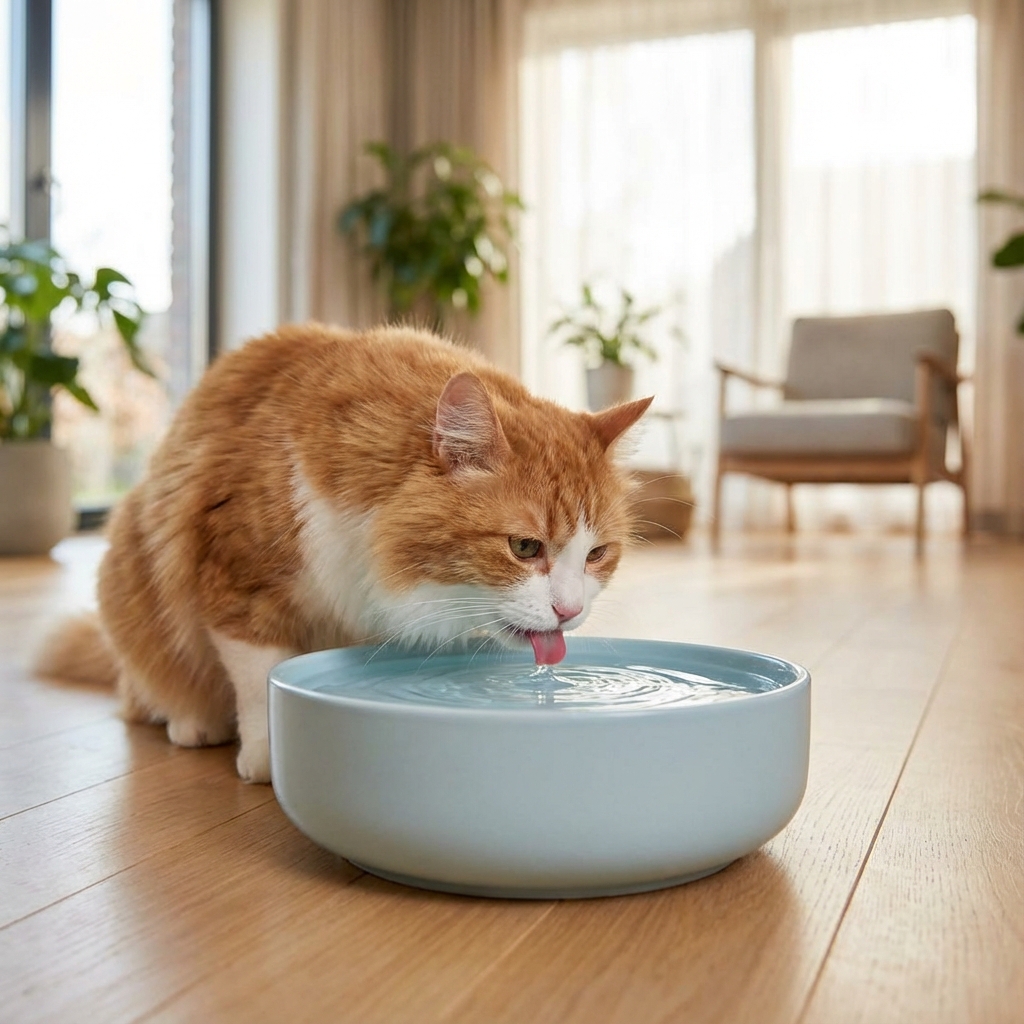

You fill your cat’s water bowl every morning, and by evening it looks completely untouched. Meanwhile, you’re Googling “how much water should a cat drink” at 2 AM, worried about kidney disease and urinary blockages. You’re not paranoid—cats are notoriously terrible at staying hydrated.
Quick Answer: Cats evolved from desert-dwelling ancestors and have a naturally low thirst drive. To increase water intake, offer multiple wide, shallow water sources away from food and litter boxes, add water fountains for movement attraction, mix water into wet food, and try ice cubes or bone broth as flavor enhancers. Most cats need 3.5-4.5 ounces of water per 5 pounds of body weight daily.
This guide is based on recommendations from veterinary nephrologists (kidney specialists), feline nutrition research, and clinical case studies on chronic kidney disease prevention.
In this guide, you’ll discover:
- Why cats don’t drink like dogs (evolutionary biology)
- How to calculate your cat’s exact water needs
- 11 proven methods to increase water consumption
- Signs of dehydration you might be missing
- When low water intake becomes a medical emergency
- Special considerations for kittens, seniors, and kidney disease cats
Why Cats Are Terrible at Drinking Water (It’s Not Laziness)
The Desert Cat Legacy
Domestic cats descended from Felis silvestris lybica, the African wildcat that evolved in arid desert environments. These ancestors obtained 70% of their hydration from prey (mice, birds), drinking water only occasionally.
Modern problem: Your indoor cat eats dry kibble (10% moisture) instead of fresh mice (70% moisture), but their biology still says “I don’t need to drink much.”
The math doesn’t add up:
- Wild cat eating 3 mice: 60-70ml water from prey
- Domestic cat eating dry food: 8-12ml water from food
- Hydration deficit: 50ml+ that must come from drinking
Many cats don’t compensate by drinking more—they just exist in chronic mild dehydration.
Why This Matters: Health Consequences
Chronic dehydration contributes to:
- Chronic Kidney Disease (CKD) - affects 30-40% of cats over age 10
- Urinary crystals and stones - concentrated urine = crystal formation
- Feline Lower Urinary Tract Disease (FLUTD) - painful urination, blockages
- Constipation - dehydrated stool = megacolon over time
Research findings:
- Cats eating only dry food have 2.5x higher risk of urinary issues vs wet food cats
- Increasing water intake by just 20% reduces urinary crystal formation by 40%
- Senior cats (10+) need 15-20% more water than young adults due to decreased kidney efficiency
How Much Water Should Your Cat Actually Drink?
The Formula
Daily water need = Body weight (lbs) × 0.7 to 0.9 ounces
Examples:
- 8 lb cat: 5.6 - 7.2 ounces per day
- 12 lb cat: 8.4 - 10.8 ounces per day
- 15 lb cat: 10.5 - 13.5 ounces per day
Important: This is total water intake, including:
- Water drunk from bowls
- Moisture in food (dry food = 10%, wet food = 78%)
- Water added to food
Calculating Total Daily Intake
Example: 10 lb cat eating dry food
Water needs: 10 × 0.8 = 8 ounces total
Scenario 1 - Dry Food Only:
- Dry food (1 cup = 100g): 10ml water
- Must drink: 226ml (7.6 oz) from bowl
- Reality: Most cats drink 3-4 oz → chronic deficit
Scenario 2 - Mix of Wet + Dry:
- Dry food (½ cup): 5ml water
- Wet food (3 oz can): 65ml water
- Must drink: 166ml (5.6 oz) from bowl
- Reality: More achievable target
Scenario 3 - Wet Food Only:
- Wet food (2 × 3oz cans): 130ml water
- Must drink: 106ml (3.6 oz) from bowl
- Reality: Most cats easily achieve this
Conclusion: Wet food dramatically reduces the drinking burden on cats.
11 Vet-Approved Tricks to Increase Water Intake
1. Switch to Wide, Shallow Bowls
Why it works: Cats hate their whiskers touching bowl sides (whisker fatigue). Deep, narrow bowls force whiskers to bend uncomfortably.
How to implement:
- ✅ Use bowls 5-6 inches diameter, 1-2 inches deep
- ✅ Ceramic or stainless steel (not plastic—can harbor bacteria and cause chin acne)
- ✅ Fill to brim daily (cats prefer surface water, won’t bend down into half-empty bowl)
Expected result: 15-25% increase in drinking frequency
2. Place Multiple Water Stations Throughout House
Why it works: Cats are opportunistic drinkers—they drink when they encounter water, not when they feel thirsty.
Strategic placement:
- Minimum 3 stations in multi-level homes
- Place near favorite sleeping spots (they drink after naps)
- Near sunny windows (drinking after sunbathing)
- Far from litter boxes (10+ feet—cats won’t drink near bathroom)
- Separate from food (in nature, water sources aren’t at kill sites—prevents contamination)
Bonus: Some cats prefer specific rooms. Try kitchen, bedroom, bathroom, living room and see which gets used most.
3. Add a Cat Water Fountain
Why it works: Moving water attracts cats (instinct says flowing water = fresh, still water = stagnant/unsafe). The sound and movement trigger interest.
Fountain benefits:
- Oxygenated water tastes fresher
- Filtration removes debris and odors
- Multiple drinking surfaces (stream, bowl, bubbles)
- Appeals to cats who paw at water bowls (they want movement!)
Maintenance is key:
- Clean weekly (prevents biofilm buildup)
- Change filters monthly
- Use distilled water if you have hard water (prevents mineral deposits)
Expected result: 30-50% increase in water intake for fountain-motivated cats
Cat personality match:
- ✅ Loves fountains: Young cats, playful cats, cats who paw at bowls
- ❌ May dislike: Senior cats with hearing loss (noise), timid cats (motor sound)
4. Try Ice Cubes as “Toys”
Why it works: Many cats enjoy batting ice cubes across floor (prey instinct), then licking the water trail. It’s play + hydration.
How to make it irresistible:
- Drop 2-3 ice cubes in shallow bowl or empty bathtub
- Use fish-shaped ice cube trays (novelty factor)
- Freeze low-sodium chicken broth instead of plain water
Best for: Playful cats under age 7
5. Flavor the Water (Carefully)
Why it works: Bland water doesn’t excite obligate carnivores. Meat-flavored water smells like prey.
Safe flavor enhancers:
- ✅ Bone broth (low-sodium, no onions/garlic) - dilute 1:4 ratio (1 part broth, 4 parts water)
- ✅ Tuna water from canned tuna (in water, not oil) - use sparingly, 1 tsp per bowl
- ✅ Clam juice (unsalted) - 1 tsp per cup of water
- ✅ Chicken or turkey drippings (skim fat off top first)
What NOT to add:
- ❌ Milk (most cats are lactose intolerant → diarrhea)
- ❌ Salt (increases kidney burden)
- ❌ Human broths with onion/garlic (toxic to cats)
Start conservatively: Very subtle flavor. If water smells too strong, cats may avoid it.
6. Mix Water Into Wet Food
Why it works: Cats don’t notice extra moisture in already-wet food. You’re sneaking hydration into meals.
Method:
- Start with 1 tablespoon water mixed into each meal
- Gradually increase to 3-4 tablespoons over 2 weeks
- Should look like “soupy” pate, not swimming
Pro tip: Warm the food slightly (5 seconds microwave) after adding water—releases aroma, masks water addition.
Expected result: Extra 2-3 oz water daily (significant boost)
7. Feed Wet Food Instead of (or Alongside) Dry Food
Why it works: This is the single most effective hydration strategy. Wet food is 70-80% water vs dry food’s 10%.
Comparison:
- 3 oz wet food: ~65ml water
- Same calories in dry food: ~8ml water
- Difference: 57ml extra hydration per meal
Transition tips:
- Mix wet and dry 50/50 if cat is resistant
- Choose pate over chunks (higher moisture content)
- Avoid “gravy” style (cats lick gravy, leave chunks)
Budget concern? Even one wet meal per day helps. Mix ½ can wet + ½ portion dry for breakfast, full dry for dinner.
8. Let Them Drink From Faucets (Supervised)
Why it works: Many cats are obsessed with running tap water—combines movement, freshness, and height preference.
Safe practice:
- Turn on faucet to gentle stream (not full blast)
- Allow 5-10 minutes supervised drinking
- Do this 2-3x daily (after meals, before bed)
Consider installing: Pet fountain attachment for bathroom/kitchen sink (allows unsupervised access)
Caution: Don’t encourage if you have hard water high in minerals—contributes to urinary crystals.
9. Try Different Water Temperatures
Why it works: Cats have temperature preferences (like humans preferring cold vs room-temperature water).
Experiment:
- ✅ Cold water: Add 1-2 ice cubes (mimics fresh stream)
- ✅ Room temperature: Leave bowl out 2 hours before offering
- ✅ Slightly warm: Add splash of warm water (releases no scent, feels “fresh kill”)
Observation: Which bowl empties first over 3 days? That’s your cat’s preference.
10. Use Glass or Ceramic Instead of Plastic
Why it works:
- Plastic absorbs odors and bacteria (smells bad to sensitive cat noses)
- Plastic bowls can cause feline acne (chin bumps) from bacteria
- Glass/ceramic stays odor-neutral and is easier to sterilize
Upgrade:
- Dishwasher-safe ceramic bowls (high-temp cleaning kills bacteria)
- Weighted bases prevent tipping
- White or light colors show when water needs changing
11. Create Positive Water Associations
Why it works: Classical conditioning—pair water drinking with rewards.
Training protocol:
- Every time you see cat drinking, softly say “good drink” + treat within 3 seconds
- After 1 week, cat associates water bowl with treats
- Start rewarding every other drink, then every third
- Eventually, drinking itself becomes rewarding
Works best for: Food-motivated cats, kittens
Measuring Water Intake: How to Track Progress
Method 1: Marked Bowl
- Use measuring cup to fill bowl with exact amount (e.g., 200ml)
- Mark water level with tape on outside of bowl
- After 24 hours, measure what remains
- Subtract to find consumption
Example:
- Filled with 200ml
- 150ml remains after 24h
- Cat drank 50ml (1.7 oz)
Method 2: Weight Tracking
For cats eating wet food with water added:
- Weigh empty food bowl
- Add food + water, weigh again
- After cat eats, weigh bowl with leftovers
- Calculate: (Starting weight - End weight) = consumed
What’s Normal vs Concerning?
Normal hydration:
- Drinks small amounts (1-3 laps) multiple times per day
- Urinates 2-4 times per 24 hours
- Urine is light yellow
- Skin “tents” snap back immediately when gently pinched
Concerning signs:
- ⚠️ Drinks excessively (12+ oz/day for 10 lb cat = possible diabetes/kidney disease)
- ⚠️ Doesn’t drink for 24+ hours
- ⚠️ Urine is dark amber or orange
- ⚠️ Urinating less than 2x daily or straining to urinate
- ⚠️ Skin stays “tented” for 2+ seconds (dehydration test)
Signs of Dehydration You Might Miss
Mild Dehydration (5% fluid loss)
- Slightly tacky gums (not wet and slippery)
- Less playful than usual
- Sleeping more than normal
Moderate Dehydration (7-8% fluid loss)
- Sunken eyes
- Skin tent stays up 2-3 seconds
- Dry, pale gums
- Lethargy
Severe Dehydration (10%+ fluid loss) - EMERGENCY
- Skin tent stays up indefinitely
- Cold extremities (ears, paws)
- Rapid heart rate
- Collapse or inability to stand
If you suspect moderate-to-severe dehydration: Emergency vet visit. IV fluids may be needed.
Special Situations: When Standard Tricks Aren’t Enough
Chronic Kidney Disease (CKD) Cats
Cats with kidney disease need 20-30% more water than healthy cats but often drink less due to nausea.
Advanced strategies:
- Subcutaneous fluids at home: Vet teaches you to give IV fluids under skin 2-3x weekly
- Prescription wet food: Hill’s k/d, Royal Canin Renal have added moisture + kidney support
- Appetite stimulants: Mirtazapine helps cats eat/drink when nauseous
Monitoring: CKD cats need bloodwork every 3-6 months to track kidney values (creatinine, BUN).
Kittens (Under 6 Months)
Kittens are at higher dehydration risk—smaller bodies lose water faster.
Kitten-specific tips:
- Very shallow bowls (½ inch deep)—they’re clumsy and can fall in
- Place water bowl next to (not inside) play area—drink after play session
- Wet food only until 6 months (easiest to meet hydration needs)
- Never restrict water access (some owners mistakenly do this for litter training)
Senior Cats (10+ Years)
Older cats often have:
- Decreased kidney function (need more water)
- Dental pain (makes drinking uncomfortable)
- Arthritis (can’t bend down to low bowls)
Senior accommodations:
- Elevated bowls (4-6 inches high) to reduce neck bending
- Room-temperature or warm water (easier on sensitive teeth)
- Multiple stations on each floor (reduces walking distance)
- Soften dry food with water if dental disease prevents chewing
Cats Recovering From Urinary Blockage
Male cats especially prone to urethral blockages (life-threatening emergency).
Post-blockage protocol:
- Wet food ONLY (minimum 6 months, ideally permanent)
- Prescription urinary diets (dissolves crystals)
- Water fountains to encourage constant drinking
- Monitor litter box daily—if no urine for 12h, emergency vet visit
Goal: Dilute urine to prevent crystal reformation. Concentrated urine = crystals return.
When to See a Veterinarian
Situations Requiring Immediate Vet Visit:
- ❌ No urination in 12+ hours (possible blockage—life-threatening in males)
- ❌ Straining to urinate, crying in litter box (painful, possible blockage)
- ❌ Blood in urine
- ❌ Sudden increase in water intake (drinking entire bowl multiple times daily—possible diabetes, kidney disease, hyperthyroidism)
- ❌ Vomiting after drinking (possible kidney disease, gastritis)
- ❌ Extreme lethargy with skin tenting
Routine Checkup Discussion Points:
At your annual exam, ask your vet to:
- Calculate your cat’s ideal water intake based on weight and diet
- Check hydration status (skin tent test, gum moisture)
- Run bloodwork for cats 7+ years (check kidney values: creatinine, BUN, SDMA)
- Recommend specific foods if your cat has low water intake
Common Mistakes Cat Owners Make
Mistake #1: Placing Water Next to Food
The problem: In nature, cats don’t eat near water sources (prey carcasses contaminate water). Instinct says food + water together = unsafe water.
The fix: Separate by 5+ feet minimum. Different rooms is even better.
Mistake #2: Using Too-Small Bowls
The problem: Narrow bowls cause whisker fatigue (painful overstimulation). Cats avoid drinking rather than endure discomfort.
The fix: Width matters more than depth. 5-6 inch diameter minimum.
Mistake #3: Changing Water Too Infrequently
The problem: Dust, hair, food particles fall into water within hours. Cats have much more sensitive smell and taste than humans.
The fix: Fresh water twice daily minimum. Rinse bowl with hot water daily, soap wash every 3 days.
Mistake #4: Only Offering One Water Source
The problem: If that bowl is blocked (by another pet), in “wrong” location, or runs out, cat goes without.
The fix: Minimum 2 stations per cat, plus 1 extra. (2 cats = 5 water bowls)
Mistake #5: Assuming Cats Will Drink When Thirsty
The problem: Unlike dogs, cats have defective thirst drives. They’ll tolerate mild dehydration rather than actively seek water.
The fix: Make water unavoidable—multiple stations, fountains, wet food. You manage hydration, not the cat.
Quick Reference: Water Intake Boosting Cheat Sheet
Immediate (Today):
- Switch to wide, shallow bowls
- Add second water station away from food
- Offer ice cube to bat around
This Week:
- Mix 2 tablespoons water into wet food meals
- Try tuna water flavoring (1 tsp)
- Measure baseline water consumption with marked bowl
This Month:
- Transition to 50%+ wet food diet
- Purchase cat water fountain
- Schedule vet checkup if cat is 7+ years old
Long-Term:
- Monitor litter box for urination frequency (2-4x daily = healthy)
- Track weight (sudden loss = possible kidney disease)
- Senior cats (10+): bloodwork every 6-12 months
Frequently Asked Questions
How do I know if my cat is drinking enough water?
Check for these positive signs: urinates 2-4 times daily, urine is pale yellow (not dark), gums are wet and slippery, skin snaps back immediately when gently pinched (hydration test). If any of these are off, increase water intake strategies.
Can cats drink too much water?
Yes—excessive drinking (polydipsia) is a symptom of diabetes, kidney disease, or hyperthyroidism. If your 10 lb cat drinks more than 12 oz daily consistently, see a vet for bloodwork. Normal drinking is distributed throughout the day; excessive is gulping large amounts frequently.
Is tap water safe for cats?
Generally yes if it’s safe for humans, but hard water (high mineral content) may contribute to urinary crystals in susceptible cats. If your area has very hard water, consider filtered or distilled water. Avoid softened water (high sodium).
My cat only drinks from my water glass. Is that okay?
It’s safe but not ideal hygienically. Cats prefer elevated water sources and may like the glass material. Instead of breaking the habit, place identical glasses (dedicated for cat) around the house at elevated spots. Wash daily.
How long can a cat go without water?
Cats can survive 3-4 days without water, but organ damage begins after 24-48 hours. If your cat hasn’t drunk anything in 24 hours and shows lethargy, see a vet immediately for possible subcutaneous fluid treatment.
Do cats need water if they eat wet food?
Yes, but much less. A cat eating 100% wet food gets 70-80% of their water needs from food, but still needs to drink 2-4 oz from bowls daily. Never remove water bowls, even for wet food-only cats.
Why does my cat paw at the water bowl before drinking?
This is instinctive behavior from wildcats who paw at water sources to test depth and safety, or to create movement (moving water = fresh). Provide a fountain to satisfy this instinct, or use a heavy bowl that won’t tip when pawed.
Can dehydration cause urinary blockages?
Yes—dehydration concentrates urine, which promotes crystal formation. Crystals can clump and block the urethra (especially in male cats). This is a life-threatening emergency requiring immediate vet care. Prevention: high water intake + wet food diet.
Real Success Story: From Chronic UTIs to Thriving
Case study: “Milo,” 6-year-old male domestic shorthair
Problem: Recurring urinary tract infections (UTIs) every 2-3 months, one urethral blockage requiring emergency surgery ($3,000).
Investigation: Vet found Milo drank only 2 oz water daily (needed 6-7 oz). Diet was 100% dry food.
Intervention:
- Switched to 75% wet food, 25% dry
- Added water fountain in bedroom (his favorite room)
- Mixed 3 tablespoons water into each wet food meal
- Placed 4 water bowls throughout house
Results:
- Water intake increased to 8 oz daily within 2 weeks
- No UTIs in following 18 months
- Lost 2 lbs excess weight (wet food is less calorie-dense)
- Owner reports he’s more energetic and playful
Cost comparison:
- Prevention supplies (fountain + wet food): $40/month
- Previous UTI treatments: $200+ every 2 months
Lesson: Small investments in hydration prevent massive vet bills.
Final Thoughts: Make Water Irresistible
Your cat’s desert-dwelling ancestors didn’t need to drink much water—they ate water-rich prey. But your modern cat eating kibble absolutely needs your help staying hydrated.
The good news? You don’t need expensive solutions. Wide bowls, multiple stations, and wet food accomplish 80% of the goal. Add a fountain and some flavor, and you’ve covered the remaining 20%.
Start with the easiest changes:
- Wide, shallow bowls
- Multiple water stations
- Mix water into food
- Add one wet food meal per day
Within 2 weeks, you should see increased drinking and more frequent urination (sign of healthy hydration). Your future senior cat will thank you with healthier kidneys and fewer urinary issues.
Last Updated: January 2026