
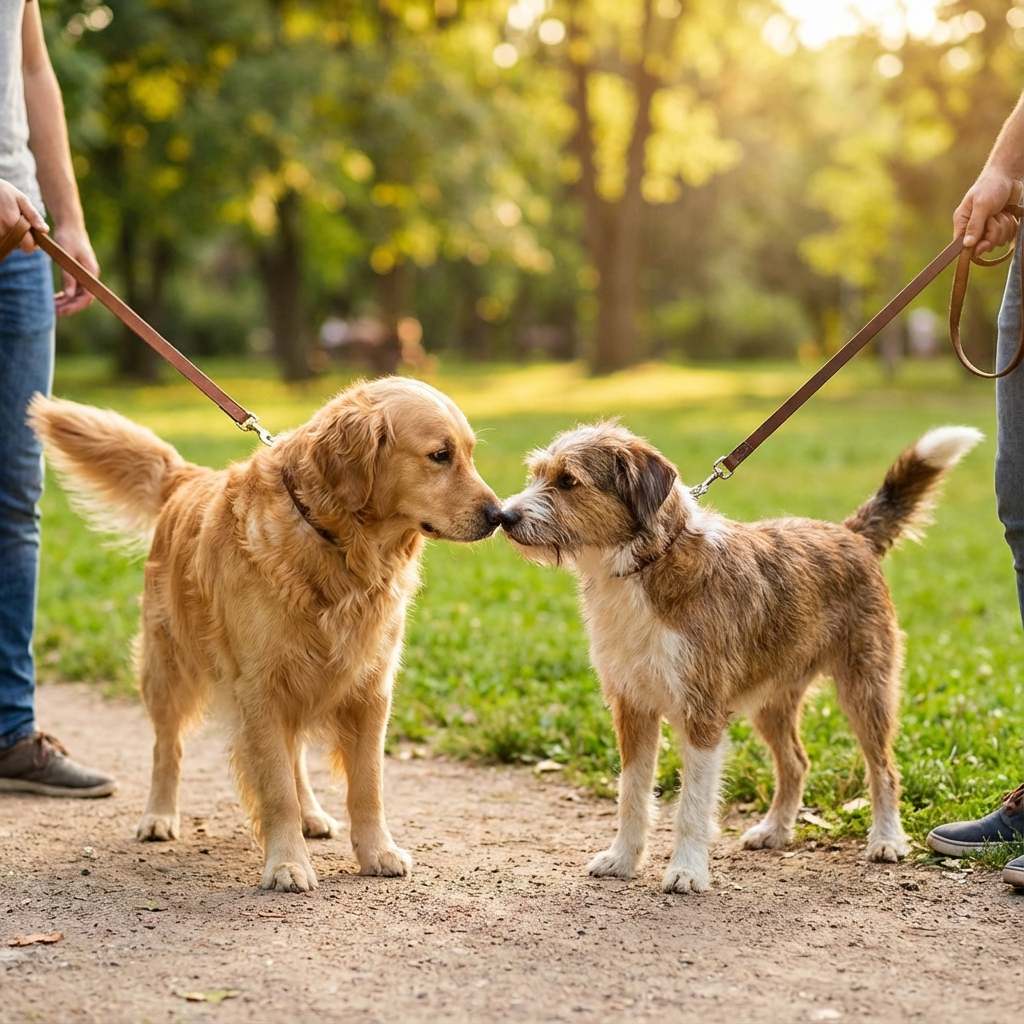

Bringing a second dog home should be exciting—not terrifying. But if you’ve ever watched two dogs meet for the first time and seen the hackles go up, you know that introductions can go sideways fast. One wrong move can create months of tension, resource guarding, or worse.
Quick Answer: The safest way to introduce two dogs is through a neutral-territory meeting (not your home), followed by parallel walks where they can see each other without direct interaction, then gradually supervised home introductions over 7-14 days. Never force face-to-face contact in the first 24 hours.
This guide is based on protocols from certified professional dog trainers (CPDT-KA), veterinary behaviorists, and successful multi-dog household case studies.
In this guide, you’ll learn:
- Why the first introduction location determines success or failure
- Step-by-step timeline from Day 1 to Week 2
- Body language signals that mean “slow down” vs “all clear”
- Common mistakes that create aggression patterns
- How to manage the first night and feeding times
- When to call a professional trainer (red flags)
Why the First Introduction Matters More Than You Think
The first meeting between two dogs creates a lasting impression—literally. Dogs form associative memories, meaning if the first encounter is stressful or confrontational, they’ll approach every future interaction with that same tension.
Research shows:
- Dogs introduced in neutral territory have 73% fewer aggression incidents in the first month compared to home introductions
- Parallel walking before face-to-face meetings reduces initial tension by 45%
- Slow introductions (7-14 days) result in better long-term relationships than rushed same-day bonding
The goal isn’t to force friendship on Day 1—it’s to prevent negative associations while giving both dogs time to adjust.
Pre-Introduction Preparation (Do This BEFORE You Bring the New Dog Home)
1. Assess Your Resident Dog’s Personality
Good Candidates for a Second Dog:
- ✅ Socializes well at dog parks or doggy daycare
- ✅ Has had positive experiences with other dogs during walks
- ✅ Doesn’t resource guard (food, toys, you)
- ✅ Responds reliably to basic commands (sit, stay, leave it)
Challenging Candidates (Proceed with Caution):
- ⚠️ History of dog-dog aggression or reactivity
- ⚠️ Resource guards food, toys, or spaces
- ⚠️ Never properly socialized with other dogs
- ⚠️ Senior dog with health issues that limit mobility
Important: If your resident dog has bitten another dog or shows severe reactivity, consult a certified veterinary behaviorist (DACVB) before adding a second dog.
2. Set Up Separate Spaces
Before bringing the new dog home, create physical boundaries:
Essential Supplies:
- Baby gates (minimum 2) to create separate zones
- Separate feeding stations at least 10 feet apart
- Duplicate resources: 2 water bowls, 2 beds, 2 toy sets
- Crates or ex-pens if either dog is crate-trained
Place gates to create a “safe room” where the new dog can decompress for the first 3-7 days without visual access to the resident dog.
3. Choose Your Introduction Team
You’ll need 2-3 people for the first introduction:
- Handler 1: Manages resident dog (should be someone the dog knows and trusts)
- Handler 2: Manages new dog (ideally the person who transported them)
- Handler 3 (Optional): Troubleshoots—opens doors, removes obstacles, holds leashes during transitions
Each handler needs a 6-foot leash (not retractable) and high-value treats (chicken, cheese, hot dogs).
The Introduction Timeline: Days 1-14
Day 1: Neutral Territory Meeting
Step 1: Choose the Right Location (NOT Your Home)
Best neutral locations:
- ✅ Quiet park with walking paths (avoid dog parks—too stimulating)
- ✅ Empty school yard or tennis court
- ✅ Wide, quiet street in an unfamiliar neighborhood
- ❌ Your yard, house, or car—these belong to the resident dog
Why neutral territory? Your home is your resident dog’s territory. Bringing a stranger directly into that space triggers territorial behavior. Neutral ground levels the playing field.
Step 2: Parallel Walking (15-30 Minutes)
This is the secret weapon professional trainers use:
- Start 20-30 feet apart walking in the same direction (parallel)
- Both dogs should be able to see each other but focus on walking
- Every time either dog looks at the other calmly, mark with “yes!” and treat
- Gradually decrease distance over 15-20 minutes (move 3-5 feet closer every 5 minutes)
- Stop when dogs are 6-10 feet apart, still walking parallel
Body language to watch:
- ✅ Good signs: Loose body, soft eyes, occasional glances, wagging tail (not stiff)
- ⚠️ Warning signs: Stiff body, hard stare, raised hackles, tucked tail, growling, lunging
If you see warning signs, increase distance immediately and continue parallel walking until both dogs relax.
Step 3: The Sniff Test (Only If Both Dogs Are Calm)
If parallel walking went well for 20+ minutes:
- Stop walking while still parallel (6-10 feet apart)
- Allow dogs to approach each other on loose leashes
- Let them sniff for 3-5 seconds, then call them away with treats
- Repeat 3-4 times: approach, sniff briefly, separate
Important rules:
- ❌ Never let leashes tangle (creates trapped feeling)
- ❌ Don’t let sniffing last more than 5 seconds (prevents over-arousal)
- ❌ Don’t force it—if either dog avoids the other, respect that
Red flags to abort the meeting:
- Stiff body with hard stare (precursor to fight)
- Prolonged mounting (dominance challenge)
- Growling that doesn’t de-escalate
- Air snapping or showing teeth
If you see red flags, separate dogs, return to parallel walking 30 feet apart, and try again in 2-3 days.
Day 1: First Hours at Home
Arrival Protocol
When bringing both dogs home after the neutral meeting:
- New dog enters FIRST into their designated safe room
- Give them 10-15 minutes to explore and decompress (no resident dog present)
- Then bring resident dog home through their normal routine
This prevents the resident dog from feeling like their territory is being invaded while they’re present.
Visual Barrier for First 24-48 Hours
For the first 1-2 days, dogs should be separated by baby gates or closed doors:
- They can smell each other under doors (scent introduction)
- They can hear each other’s daily routines
- No visual contact yet to prevent over-excitement
Feed meals on opposite sides of the barrier—this creates positive associations (“other dog = food appears”).
Days 2-3: Scent Swapping
Before face-to-face meetings at home, let dogs learn each other’s scents:
Scent Swap Exercise:
- Rub a towel on resident dog’s body
- Place that towel in new dog’s space
- Rub a different towel on new dog
- Place in resident dog’s space
Watch for reactions:
- ✅ Curious sniffing, moving on = positive
- ⚠️ Prolonged fixation, whining, scratching at barrier = need more time
Days 4-7: Visual Contact Through Barriers
Upgrade from closed doors to baby gates:
Gate Training Protocol:
- Feed meals on opposite sides of gate (start 10 feet apart)
- Move feeding stations 1 foot closer to gate each meal
- Goal: Both dogs eating calmly 2-3 feet from gate
Controlled Visual Exposure:
- Allow 5-10 minutes of supervised visual contact through gate
- Reward calm behavior (looking, sniffing, then disengaging)
- If either dog fixates, barks excessively, or scratches at gate, reduce visual access
Days 7-10: Supervised Room Sharing
If gate feeding and visual contact have gone well for 3 days:
First Shared Space Session (Living Room or Yard):
- Tire both dogs out first with separate 30-minute walks
- Resident dog enters shared space first, settles on bed/mat
- New dog enters on leash with handler
- Keep 10 feet distance initially
- Practice obedience commands (sit, down) with treats
- Session lasts 10-15 minutes maximum
- Separate before either dog gets over-excited
Repeat 2-3x daily, gradually:
- Increase session length (add 5 minutes every 2 days)
- Decrease distance between dogs
- Reduce leash tension (but keep leashes on for safety)
Days 10-14: Off-Leash Supervised Interaction
If leashed sessions have been consistently calm for 3+ days:
First Off-Leash Session:
- Choose a neutral room (not resident dog’s favorite sleeping spot)
- Remove all high-value resources (toys, bones, food)
- Keep sessions short (15-20 minutes)
- Watch for play signals:
- ✅ Play bows (front down, rear up)
- ✅ Bouncy movements
- ✅ “Self-handicapping” (bigger dog holding back)
- ✅ Role reversals (taking turns chasing)
When to interrupt play:
- One dog persistently avoids or hides
- Play becomes one-sided (one always chasing, other always fleeing)
- Vocalizations escalate from playful to serious
- Body language stiffens
Guideline: Interrupt play every 3-5 minutes with a “break” cue, call both dogs to you for treats, then release to play again. This teaches impulse control and prevents over-arousal.
Managing Key Situations
Feeding Time (Critical!)
For the First 2-4 Weeks:
- Feed in completely separate rooms with closed doors
- Adult dog eats first (respects hierarchy)
- Wait until both finish before opening doors
Why separation matters: Resource guarding over food is the #1 cause of multi-dog household fights. Even dogs who seem friendly can become possessive during meals.
First Night Sleeping Arrangements
Options:
Option 1: Separate Rooms (Safest)
- New dog sleeps in their safe room with door closed
- Resident dog maintains normal sleeping spot
- Prevents overnight incidents when you can’t supervise
Option 2: Same Room, Separate Crates
- Only if both dogs are crate-trained and crates are 6+ feet apart
- Cover crates partially to reduce visual stimulation
- White noise machine helps mask sounds that might trigger barking
What NOT to do:
- ❌ Let them sleep together in first 2 weeks (risk of overnight fight)
- ❌ Assume silence means tolerance (dogs can fight suddenly when over-threshold)
Toys and Resource Management
For First Month:
- No shared toys (each dog has their own set in their own color)
- No high-value chews (bully sticks, bones) when together
- Interactive toys (tug, fetch) happen during separate one-on-one time
Test for resource guarding: Around Week 3, drop a low-value toy equidistant between both dogs while supervised. Watch for:
- ✅ Both ignore it or one takes it without tension = good
- ⚠️ Stiff body, blocking, growling = needs professional training help
Body Language Guide: What Your Dogs Are Telling You
Positive Signals (Keep Going)
- Loose, wiggly body (especially rear end)
- Play bow (front legs down, rear up, might bark playfully)
- Taking turns in chase games
- Soft eye contact with looking away (appeasement)
- Relaxed mouth (open, tongue out)
- Bouncy, exaggerated movements
Warning Signals (Slow Down or Separate)
- Freeze (completely still, staring)
- Whale eye (whites of eyes showing)
- Lip licking, yawning (stress signals, not playful)
- Low, rumbling growl (different from playful growl)
- Raised hackles along spine
- Stiff, slow-motion movements (stalking posture)
- One dog pinned, trying to escape while other persists
If you see warning signals: Interrupt immediately with a verbal cue (“break!”, “enough!”), call dogs to separate areas, give them 10-15 minutes apart to decompress.
Common Mistakes That Sabotage Introductions
Mistake #1: Rushing the Timeline
The Problem: “They seemed fine after 2 days, so I left them alone together.”
The Fix: Follow the 2-week rule minimum. Many dog fights happen in Week 2-3 when novelty wears off and true personalities emerge.
Mistake #2: Treating Them as a “Pack” Too Soon
The Problem: Feeding together, walking both on the same leash, forcing them to share toys.
The Fix: Maintain individuality for 4-6 weeks. Each dog needs one-on-one time with you daily.
Mistake #3: Ignoring the Resident Dog
The Problem: Giving all attention to the cute new puppy/dog while resident dog watches.
The Fix: Resident dog gets priority in all things—fed first, greeted first, petted first. This reduces jealousy and reinforces household hierarchy.
Mistake #4: Punishing Warning Signals
The Problem: Yelling “no!” when a dog growls during introduction.
The Fix: Growling is communication, not misbehavior. It means “I’m uncomfortable, please give me space.” Punishing growls teaches dogs to skip warnings and bite without notice.
Mistake #5: Using Punishment-Based Training
The Problem: Using prong collars, shock collars, or alpha rolls during introductions.
The Fix: Force and intimidation create fear and defensiveness—the opposite of what you want. Use positive reinforcement (treats, praise) for calm behavior.
When to Call a Professional Trainer
Some situations require expert help. Contact a certified professional dog trainer (CPDT-KA) or veterinary behaviorist (DACVB) if:
- ❌ Either dog has broken skin in a fight
- ❌ Consistent growling/snapping that doesn’t improve after 2 weeks
- ❌ One dog obsessively stalks or fixates on the other
- ❌ Resource guarding escalates despite management
- ❌ You feel unsafe or overwhelmed managing them
Finding qualified help:
Age and Size Pairing: Special Considerations
Puppy + Adult Dog
Advantages:
- Adult dogs often tolerate puppy rudeness (“puppy license”)
- Puppy learns dog social skills from adult
Challenges:
- Puppy energy can overwhelm senior or low-energy adult
- Adult may snap to correct puppy—this is normal IF it’s a warning, not injury
Management:
- Give adult dog puppy-free zones and quiet time
- Exercise puppy separately so they’re calmer around adult
- End play sessions before adult shows irritation
Small Dog + Large Dog
Safety First:
- Supervise ALL interactions for 6+ months (size difference = injury risk)
- Teach large dog “gentle” around small dog
- Prevent large dog from play-bowing over small dog (can injure accidentally)
- Never leave small dog accessible to large dog when you’re gone
Play Matching: Some small/large pairings work beautifully, others don’t. If play becomes one-sided with the small dog always fleeing in fear (not fun), separate play styles and provide parallel activities instead.
Two Adult Dogs of Same Sex
Reality check: Same-sex aggression (especially female-female) is real but not inevitable.
Success factors:
- Both dogs are spayed/neutered (reduces hormonal competition)
- Significant age gap (8-year-old + 2-year-old = less competition)
- Opposite energy levels (couch potato + active dog = different niches)
Higher risk pairings:
- Two adult females of same age and size (highest fight risk)
- Two intact males (testosterone = competition)
Breeds and Temperament Considerations
Dog-Friendly Breeds (Generally Easier Introductions)
- Golden Retrievers, Labrador Retrievers - bred for cooperative work
- Beagles, Basset Hounds - pack hunting background
- Cavalier King Charles Spaniels - gentle companion breed
- Collies, Shelties - often good with other dogs
Breeds Requiring Extra Caution
- Terriers (especially with small dogs/prey instinct)
- Guard breeds (Rottweilers, Dobermans—territorial instincts)
- Fighting breed heritage (Am Staffs, Pit Bulls—requires experienced handler)
- Livestock guardians (Anatolian Shepherds, Great Pyrenees—independent)
Important: Breed tendencies are generalizations. Individual temperament, socialization history, and training matter more than breed alone.
Frequently Asked Questions
How long does it take for two dogs to become friends?
Expect 4-8 weeks for dogs to settle into a comfortable routine, and 3-6 months for a genuine friendship to develop. Some dogs become best friends in days; others remain polite roommates forever. Both outcomes are fine as long as there’s no aggression.
Can I introduce dogs if my resident dog is reactive on leash?
Yes, but modify the approach: skip parallel walking and start with scent swapping and visual barriers at home. Once the new dog feels familiar (1 week), try parallel walking in a very quiet area with high-value treats. Consider hiring a trainer to help.
What if they fight during the introduction process?
Immediate steps:
- Separate dogs using barriers (chairs, gates), not hands
- Assess for injuries—any bleeding requires vet visit
- Return to previous successful step (if they fought during off-leash, go back to leashed sessions)
- Consult professional trainer before attempting further introductions
For serious fights: Consider whether this pairing is safe. Not all dogs should live together.
Should I let them “work it out” if they scuffle?
No—this is outdated advice. Small scuffles can escalate into serious fights, and rehearsing aggression makes it a habit. Always interrupt tension before it becomes physical using verbal cues and separation.
My resident dog is ignoring the new dog completely. Is that bad?
No! Ignoring is ideal in early stages. It means your resident dog isn’t threatened and is giving the new dog space. Ignore is better than over-excitement or aggression. Friendship can develop slowly over weeks.
How do I know when it’s safe to leave them alone together?
Checklist before unsupervised time:
- ✅ 4+ weeks of calm, supervised interactions
- ✅ No resource guarding incidents
- ✅ Both dogs sleep near each other without tension
- ✅ Play sessions are balanced (both taking turns)
- ✅ You’ve left them together for 5-minute intervals without issues
Even then: Start with 10 minutes alone, gradually increase. Use cameras to monitor behavior when you’re not present.
Success Stories and Realistic Expectations
What Success Looks Like
Best Case (30% of pairings):
- Dogs become inseparable best friends
- Play together daily, sleep cuddled up
- Show distress when separated
Good Case (50% of pairings):
- Dogs coexist peacefully
- Occasional play, mostly parallel activities (sleeping in same room, walking together)
- No aggression or tension
Acceptable Case (15% of pairings):
- Dogs tolerate each other but need management
- Must be fed separately, can’t share high-value items
- Cordial but not friends—this is OK!
Incompatible (5% of pairings):
- Persistent aggression despite professional help
- One dog lives in constant stress
- Solution: Rehoming one dog may be kindest option for both
Not every dog wants a canine companion, and that’s not a failure. Your job is to create the best possible outcome, whether that’s friendship or peaceful coexistence.
Final Checklist: Are You Ready?
Before bringing home your second dog, confirm:
- ✅ Resident dog has no severe behavioral issues (aggression, anxiety)
- ✅ You’ve prepared separate feeding/sleeping spaces
- ✅ You have 2-3 people available for first introduction
- ✅ You can commit to 2+ weeks of supervised management
- ✅ You have realistic expectations (not all dogs become best friends)
- ✅ You’re prepared to hire a trainer if problems arise
- ✅ You understand this is a 3-6 month process, not a 3-day project
If you checked all boxes: You’re ready for a multi-dog household. Take it slow, trust the process, and celebrate small wins. In a few months, you’ll wonder how you ever had just one dog.
Last Updated: January 2026